• Skip to main content
  • Skip to footer
Unleashed Potential
  • Classes
  • UPX
  • Board and Train
  • Day Train Program
  • Find a Trainer
    • Become A Trainer
  • The UPK9 Blog
  • Store

leash training

How to Fit a “Dominant Dog Collar” for a Reactive Dog

August 6, 2024 By Duke Ferguson Leave a Comment

In this article, I want to show you how to properly fit a dominant dog collar, or what I simply call a slip lead. This type of collar is highly effective for calming reactive dogs, especially those who are leash reactive or tend to freak out around other dogs. It’s a great tool to help your dog relax without immediately resorting to more corrective tools like pinch collars.

Why Choose a Dominant Dog Collar?

The slip lead is designed to help calm your dog. It’s not about correcting behavior through sharp jerks,or activating but rather about providing gentle control and reducing reactivity. If you have a dog that overreacts to other dogs or becomes highly excited on the leash, starting with a slip lead or a dominant dog collar can be very beneficial. A slip lead is different than a dominant dog collar but my PEI language – Island slang, often calls all the collars “slip leads. IT is good to note that Slip, leads,  slip collars, as well as dominant dog collars are all different tools by nature but can be used similar. 

NOTE: Dominant dog collar is the collar in the video and size requirements are needed, not as much for slip leads. Size and measurements differ depending on where you get the collar. 

Fitting the Dominant Dog Collar

Getting the right fit is crucial for the collar to work effectively. Here’s how to measure and fit the collar properly:

  1. Measure the Neck: Use a measuring tape or a piece of string to measure around the dog’s neck, just behind the ears. You want this measurement to be snug, as a loose collar will not stay in place.
  2. Choose the Right Size: Once you have the neck measurement, select a slip lead that matches. If the measurement is between sizes, it’s generally better to choose the smaller size to ensure a snug fit.
  3. Positioning: The collar should sit high on the dog’s neck, right behind the ears. This is critical because a collar that sits too low will not provide the control you need and can slide down.
  4. Fitting: When you put the collar on, the clip should be in your left hand with the dog facing you. This allows for easier and more effective handling. The collar should be snug enough that you can fit your fingers underneath but not so loose that you can fit your whole hand.

Checking the Fit

To ensure the collar is fitted correctly, attach the leash and pull gently. You should only see a small amount of slack, ideally just the length of your finger. If there’s more slack, the collar may be too loose and will not stay in the correct position.

Using the Dominant Dog Collar or any Slip Lead

When using the slip lead, keep in mind that it’s a tool to help your dog stay calm. It is important to teach your dog how to responded to the collar first in a few training sessions so the dog understands how to get its advantage. Teach your dog to be in control of it and learn how to remove it and avoid it.  Just before your dog starts to react or pull, add gentle pressure and known command and reinforce a sit or a different behaviour it knows and likes.  Then removing the discomfort encouraging your dog to relax and focus. It’s not meant to jerk over and over and or cause pain, but to guide and help then keep calm.

Benefits of a Proper Fit

A well-fitted slip lead:

  • Helps calm leash-reactive dogs by applying gentle pressure they want to avoid.
  • Keeps the collar in place high on the neck, where it’s most effective.
  • Prevents the collar from sliding down becoming un effective. ensuring consistent communication between you and your dog and having motivation is important. 

Final Thoughts

For reactive dogs, starting with a slip lead can make a significant difference in their behavior on walks or outings while they learn to walk. Add food for positive reinforcement in training after the release of pressure of the lead to 10X the power! It provides enough consistent control and helps to calm your dog without the need for harsh corrections.  If you’re looking for more training tips and personalized guidance, consider joining me in UPX our Unleashed Potential Experience community. We offer bi-weekly live training and coching sessions, access to our comprehensive online courses, and a supportive community to help you achieve your dog training goals. Jon a challenge, learn about breathwork and more. 

Consider UPX Personal Development and training for YOU and YOUR dog. 

For more information and to join us in UPX, visit https://www.dukeferguson.com/upx/membership and take the next step towards unleashing you and your dogs full potential. 

Filed Under: Duke Ferguson, UPK9 Main Blog

The Benefits of Walking Your Dog

February 7, 2022 By Sara Bryanton 1 Comment

Did you know walking your dog is more than just exercise? Walking your dog is filled with several benefits that not only apply to them but to you as well!

I’ll be honest, years ago as a high-performing athlete in skier cross, rugby, mountain biking, and trail running, I thought walking was boring and didn’t consider it a proper way to exercise. I feel the need…the need for speed! I worked hard to train my dogs to be off-leash so they could run and run and run! As I aged and perfect fitness eluded me I did engage in slower activities and you can most often find me snowshoeing and hiking these days with my dogs off-leash. So they run, I walk! But then in early 2020 my 5-year-old female GSD Hurtta was diagnosed with significant hip dysplasia and advanced spondylosis and our wonderful canine rehab pro Sarah MacKeigan at Upward Dog in NS assigned me to walk Hurtta on a leash twice daily. 

Here’s what I have learned over the years as a Professional Dog Trainer working with clients and other professionals in the industry.

BENEFITS OF WALKING YOUR DOG:

  • Walking uses different muscles than running or swimming. When thinking about exercising your dog you want to engage in different activities that will provide a chance to strengthen all muscles. 
  • Improves impulse control as the dog must focus on walking at your side and not be distracted therefore reactive to everything that moves or makes a sound. 
  • Going slow is good! Teaches a calmer state of mind and a desire to explore the world at a slower pace with more attention therefore walking is a great way to provide mental stimulation. 
  • Improves your relationship and bonding with your dog as you walk side by side instead of independently from one another. 
  • Greater socialization. Being kept in enclosed spaces such as backyards can cause them to be too sheltered from the world which will lower confidence and increase anxiety when around different environments, people, and other dogs. 
  • Daily walking lessons problems with dogs becoming bored, frustrated, and engaging in behaviors such as barking, destruction of property, and repetitive behaviors such as perimeter circling and attempts to escape their yards when the opportunity presents itself. (Here is where I want to tell ya about the time I was away from home for 3 hours and my door blew open and when I got home the dogs were still in the house!❤️)
  • Decreases the risk of dogs developing territorial behaviors (barking, rushing at the fence when people and dogs go by) resulting from long-term confinement to the property. 
  • Improved cardiovascular fitness, stronger core muscles, lower blood pressure, and a better more stable mood. 
  • Addresses the obesity epidemic. Most dogs today are being fed the amounts indicated on their dog food bags but those amounts were decided on decades ago when dogs spent the majority of their days outside and had jobs. They don’t take into account how many treats ppl feed their dogs these days. We are simply feeding our dogs too much and not burning off calories enough and over half of the dogs are overweight or obese. Obesity can lead to liver disease, insulin resistance, osteoarthritis and knocks a year or two off your dog’s lifespan. 
  • Decreases feelings of loneliness. Yes! Your dog can feel lonely even living with you if you don’t engage them in activities and provide them with things to do. Sometimes your dog is laying around the house simply because there is just nothing else to do.

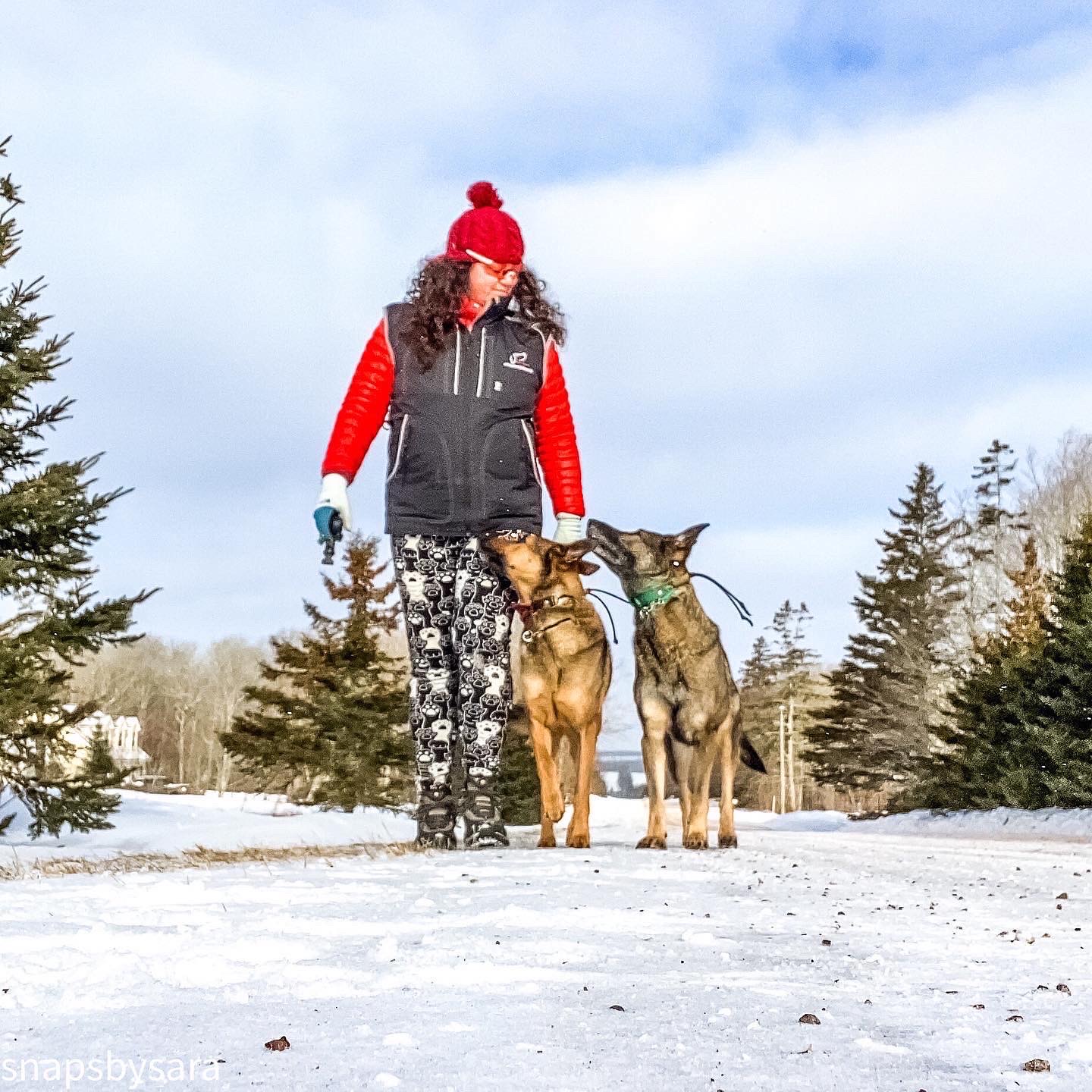
Hurtta, Kyro, and I are enjoying our daily walks immensely. I notice improvements in my mood as well and I do feel the increased bonding as we walk side by side together down the road. 

Dogs Walking

Our Signature Bungee Collars are worn by the dogs in the photo above.

Click the link or the photo to shop!


COACH SARA’S TIPS FOR WALKING:

  1. Dress for success! Wear clothing that is easy to move in, moisture-wicking, cooling in the summer, and thermal for the winter. When walking at night add in reflective or LED accessories for both you and your dog and invest in a good headlamp like the Petzl ones at Sporting Intentions in Charlottetown. 
  2. Don’t forget the poop bags!
  3. Say hello to other people! Covid has turned us all into avoidant creatures. Look up, smile, say hi!
  4. Sign you and your dog up for obedience training. Consult with a trainer about your goals and work with them to come up with a plan then take action to implement that process no matter how long it takes. 
  5. Warm-up before you start. This is important for both you and your dog. Take it slow in the beginning then increase your speed. 
  6. Stretch after. Stretch yourself and google how to stretch your dog! 
  7. Have ID tags on your dog. Just in case anything happens! 
  8. Check the dog’s gear and make sure it’s in good working order. No rips or tears in leashes, collars, or harnesses, and ensure that buckles aren’t cracked. 
  9. Get some Paw Salve to keep the pads from drying out if walking in areas that do salt on sidewalks. Also good for their noses as it doesn’t contain any fragrance or essential oils. We like the one locally made by Urban Paw.
  10. Avoid walking in extreme cold or heat. And know your breed. Some breeds can handle hot and cold weather better than others. Don’t judge someone walking a husky on a cold winter’s day. 
  11. Obey leash laws. I know I know, your dog is off-leash trained with an e-collar. Still, for everyone’s safety and comfort, leash up in areas where it’s the law. Other people don’t know that your dog is off-leash trained and may feel nervous seeing a dog with no leash on. 
  12. Bring fresh water for you both if going out for a while. 
  13. Schedule and plan your walks! Studies show that when we schedule things we are more apt to stick to them. Doesn’t matter if it doesn’t happen at the exact time you scheduled it, just matters that you did it. 

So walk on and walk far my friends!

Love, Coach Sara

Manager/Head Trainer

Unleashed Potential PEI

__________________________________________________________________________________________________________________________________

Tag us on Instagram in your walking photos for a chance to be featured!

Follow us on Facebook for more content!

Subscribe to our Youtube Channel!

__________________________________________________________________________________________________________________________________

Need help with your dog’s training but unsure of what service we offer is right for you?

Click here to explore all of our Dog Training Services


Filed Under: Sara Bryanton, Uncategorized

Footer

RSS The Weekly Recall with Duke Ferguson

  • #28 Four Ways Your Dog Is Trying to Communicate With You
    Why does your dog ignore you sometimes? Most people think it is a training issue. In reality, it is usually a communication issue. In this episode of Weekly Recall, Duke breaks down the four ways dogs actually communicate. Dogs do not rely on words the way humans do. They pay attention to scent, body language, […]

Home | Contact | Find a Dog Trainer | Dog Trainer School | Dog Training | Store | Blog | Privacy Policy


Follow Duke Ferguson on Facebook Follow Duke on YouTube Follow Duke on Instagram


Copyright © 2026 · All Rights Reserved

Unleashed Potential - Stratford, PE, C1B 2W2, Canada
Phone: (902) 367-3647 · Toll Free: (844) 364-3647

Hours of Operation:
Unleashed Potential Main Office:
Monday - Friday: 9am-4pm | Office closed on Saturdays & Sundays
Dog Training & Coaching - By appointment only