
Dogs are incredible communicators. The problem? Most people are speaking the wrong language. Here are the four channels your dog actually understands — and how mastering them will transform your relationship.
If you’ve ever found yourself repeating commands, raising your voice, or wondering why your dog tunes you out the moment you need them most, you’re not alone. I hear it every week. But here’s what I want you to understand right from the start: this is almost never a motivation problem. In my experience training dogs — and coaching the humans who love them — the real issue is almost always a communication breakdown.
Dogs don’t understand our words the way we do. When you’re talking to your dog, they’re essentially hearing “want, want, want, want.” The words themselves mean nothing until you give meaning to them. And the mismatch between how we try to communicate (mostly through language) and how dogs actually receive information is exactly where the confusion begins.
Dogs use four primary communication channels: scent, body language, vocal tone, and touch. Let me break each one down — and show you how the same principles apply to your relationships with people, too.
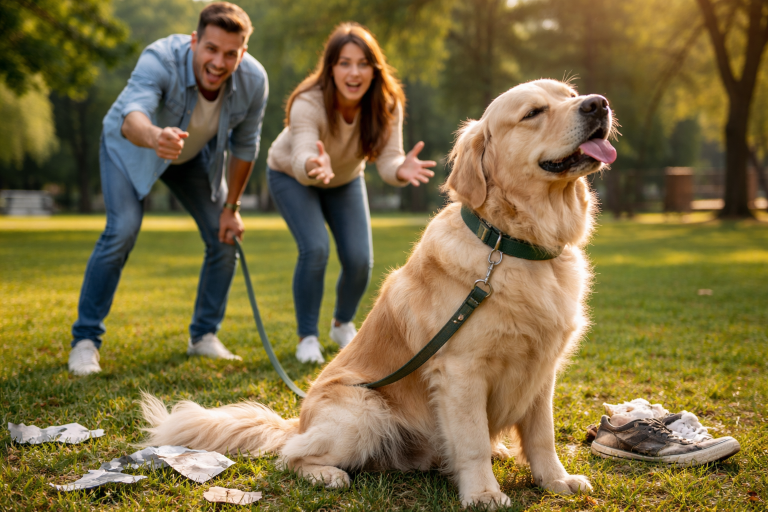
Channel 1: Scent — Your Emotional State Speaks Before You Do
Dogs live in a scent world. Their olfactory system is their primary information system, and it is extraordinarily powerful. Your dog can smell your stress hormones, your fear, your emotional state — and they’ve clocked all of it long before you’ve opened your mouth.
Think about that for a second. If you walk into a training session anxious or frustrated because of a tough phone call you just had, your dog already knows. They’re already responding to you — and not in the way you want them to.
This is why I talk so much about regulating yourself first. Breathwork matters. Calming your nervous system before you engage with your dog isn’t just a nice idea — it’s foundational. I’ve seen it with my own dog Cole, a medium-drive dog I’ve had for six years now. He is incredibly sensitive to my emotional state, and half the time, he’s the one catching me off guard and reminding me to check in with myself.
Humans aren’t that different. We don’t smell each other the way dogs do (thankfully), but we absolutely pick up on emotional energy when we walk into a room. You’ve felt the tension in a room before anyone said a word. So have your dogs — only they’re picking it up through their nose.
My challenge to you: before your next training session — or your next important conversation with a person — take three to five slow breaths. Give your nervous system at least ten seconds to settle. Calm leaders change the environment. Don’t bark; breathe first.
Ask yourself: where does your emotional state affect your dog the most? Where does it affect the people around you? That awareness alone can change everything.
Channel 2: Body Language — What You’re Saying Without Words
Dogs read body language like a book. And here’s the uncomfortable truth: they’re often reading us more accurately than we’re reading them.
A confident trainer moves calmly and clearly. Upright posture — relaxed, not rigid. Shoulders back. Moving in the direction you intend to go. Hands hanging loose at your sides. That is the body language of a calm, capable leader, and your dog feels it instantly.
Now compare that to how most of us look when we’re nervous about how our dog is about to react. Everything tightens. The shoulders come up, the hands rise above the waist, the leash gets short and tense. And what happens? The nervousness you feel about your dog’s reaction actually triggers the reaction you were dreading. It’s a loop — and your body language is the switch.
Learning to read your dog’s body language is equally important. A few stress signals to watch for: yawning when they’re not tired, lip licking, turning their head away, or the whites of their eyes showing (whale eye). Ears pinned back, panting with stress lines at the corners of the mouth. These aren’t just quirks — they’re communication.
Signs of engagement look like the opposite: forward-leaning posture, alert ears, focused eyes, relaxed breathing. When your dog’s attention is locked on you, you’ll know it.
This applies to people just as much. If you say “I’m fine” but every muscle in your body is tense, people aren’t trusting your words — they’re trusting your body. And they should. Common sense, right? Common sense is not common practice. That’s why it’s worth slowing down and actually doing it.
Here’s a quick experiment: the next time you’re about to head out for a training session, straighten your posture, lift your chin slightly, let your shoulders drop and relax. Notice how that shift changes how you feel. Your dog will notice it too — before you’ve said or done a single thing.
Channel 3: Vocal Tone — It’s Not What You Say, It’s How You Say It
Dogs weren’t born understanding English. They weren’t born understanding any human language. But they absolutely understand tone and rhythm, and they’re picking up on both constantly.
A low, rolling bark signals defensiveness — “get back, give me space.” A high-pitched squeal signals fear or panic. These are universal dog communication patterns. And the human equivalents are just as real. If I ask you the same question in a warm, open tone versus a sharp, clipped one, you’re going to give me a completely different response — or shut down entirely.
In training, I use a calm, lower “correction tone” — not angry, not sharp, just clear and grounded. “Nope. Try again.” That tells the dog there’s no reward coming without ramping up the energy in the room. My praise tone is joyful, warm, and engaged. “Good boy.” Even with my naturally deeper voice, the relationship we’ve built means my dogs respond to that tone with real enthusiasm.
The clicker is a useful tool partly because it gives a perfectly consistent tone every single time — no emotional variation, no frustration bleeding through. That consistency is powerful. But a verbal marker works just as well if you train it consistently, and it has the advantage of working even when you don’t have your clicker on you.
My bottom line on tone: calm tones reduce conflict. Reactive tones escalate it. Every time. Train your voice the same way you train your dog — with intention. Before you speak your mind, consider how you want it to land. That’s not weakness, that’s influence.
Channel 4: Touch — The Clearest Signal of All
Touch is, in my opinion, the most powerful communication channel available to us. Think about it: a dog could be blind, they could be downwind, they could be deaf — but the moment you touch them, they know you’re present. No questions asked.
Dogs are tactile animals. Watch how they explore the world — they paw things, they nudge, they investigate with contact. Touch is honest. It’s immediate. And it removes confusion. Clarity reduces stress, in dogs and in people.
In puppy work, one of the most important exercises I do is what I call “touch and feed” — as the puppy comes to me, I reach down, grab the collar, and immediately pair that touch with a food reward. This builds trust in my hands from the very start. Because here’s the thing: if a dog doesn’t trust your hands, every correction, every collar grab, every leash pop becomes a confrontation instead of a conversation.
This is also why I’m so vocal about tools like leashes, remote collars, and pinch collars being communication tools — not punishment devices. When used correctly, they are simply an extension of touch. And touch, whether through your hand or a well-conditioned collar, delivers a clear, honest signal with no ambiguity. It’s the same hand that can shake yours in a meeting, give you a reassuring squeeze on the shoulder, or offer a hug when someone is going through something hard. The tool is neutral. The relationship, and how you build it, is everything.
We respond strongly to touch as humans too. When I’ve sat with someone in hospice, sometimes touch is the only thing that reaches them. That’s how fundamental it is.
Bringing It All Together
Scent, body language, vocal tone, touch. Four channels. And here’s the thread that runs through all of them: regulation. Your regulation. When you are calm, consistent, and clear — when your emotional state, your posture, your voice, and your hands are all saying the same thing — the communication becomes simple. For your dog. For the people around you. And for yourself.
Most training problems aren’t motivation problems. Most relationship problems aren’t motivation problems. They’re communication breakdowns. And communication breakdowns are fixable — starting with you.
Take the breath. Straighten the posture. Lower the tone. Build the trust. That’s the work — and it’s available to you right now.

Leave a Reply