• Skip to main content
  • Skip to footer
Unleashed Potential
  • Classes
  • UPX
  • Board and Train
  • Day Train Program
  • Find a Trainer
    • Become A Trainer
  • The UPK9 Blog
  • Store

Duke Ferguson

Train Your Dog Using Raw Fish

October 19, 2021 By Duke Ferguson Leave a Comment

Train Your Dog Using Raw Fish

I get asked a lot about how to use raw food when training a dog. People wonder about the process I use and including how I prepare and actually carry the raw fish or any other raw meat when training.  What a training session looks like and whether or not it’s messy.

There are a variety of ways that you can use raw food to train your dog.  I love the fact that in the spring, summer and fall months I catch my dog food.  I make sure to freeze the fish for three to four weeks to kill any parasites that may be present.

Watch as I prepare and train my dogs using raw fish


If you enjoyed this video, please Subscribe to our YouTube channel (P.S. Click the bell icon to get notifications when we post a new video).


twitter imageTWEET THIS VIDEO


Steps to prepare raw fish for training

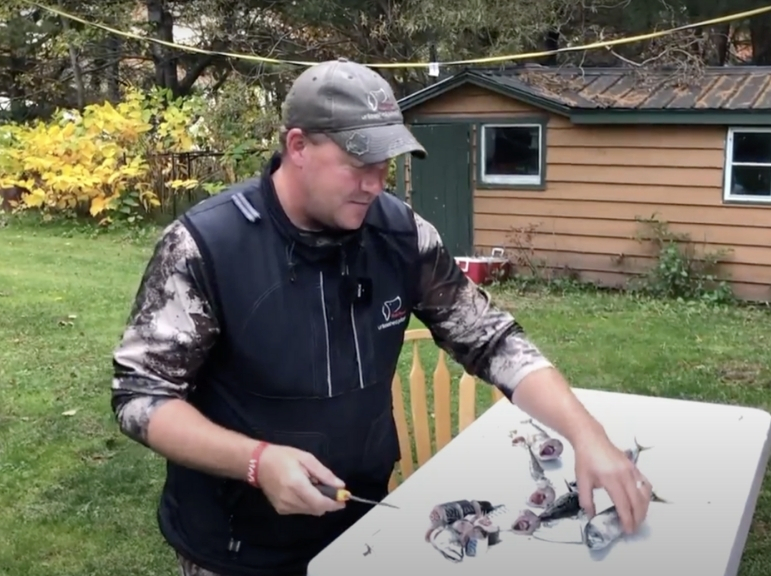
The best way to prepare the fish for training is to pre-freeze the whole fish, in this case, mackerel and cut it into bite-sized chunks.

chopping up raw fish

It’s easy to cut partially thawed fish into small pieces.  This also keeps things relatively clean for cleanup and training.


bagging raw fish for training

Plastic bags are great because they can be cleaned and reused.  You can place the bag in a pocket and easily grab chunks of raw fish.


training dog

After you have your raw fish/food prepped and ready in your pocket to the training pouch you can begin your training session with your dog.   5-10 mins are all it takes.  I use a clicker or verbal release to mark a behaviour and then feed with a piece of raw mackerel.


training black lab using raw fish

You can build excitement and energy by throwing the food and allowing your dog to catch it.


finished training session with raw fish

If after a few drills and you’re running short on time you can end your training session with a ‘jackpot’ where you empty out the bag of raw fish and let your dog enjoy!  The key is to make them work for it.


jackpot! silversides with supplements

I also like to add XDOG™ supplements to my dog’s diet.   I’ll do this when I give a bowl of food as a jackpot to help contain the powder supplements.


dog in boat with fishing rods

I am blessed to live on a beautiful island where I can fish for my dog’s food.  By feeding my dog mackerel, I get to do something I love every single day.  Fishing is one of my passions and it’s even better when I can take my dog along and build a strong bond and a trusting relationship.   Having a well-trained dog is key to being able to enjoy life together.

Takeaway tip: What’s one thing that you really love, something that’s good for you, a hobby or something that you’re passionate about that you haven’t done in a long time.  What’s taking you from it?  What changes can you make in your life to get back to doing that a little more?


XDOG™ Supplements I Use and Recommend

use coupon code UPK915 to save 15%

XDOG supplements

FOLLOW US!

facebook linkyoutube linkinstagram link


Would you like FREE  puppy training or dog training advice? OR to just learn more about Duke’s philosophy on dog training?

Contact us HERE

This mini-series is not found on YouTube.  Get Access Now  You will love it!
Free dog training videos

Filed Under: Duke Ferguson, UPK9 Main Blog

XDOG Vest Resistance Training

September 29, 2021 By Duke Ferguson Leave a Comment

XDOG™ Vest Resistance Training

When training your dog to new training equipment you should always take it one step at a time. The walk before you run concept.   It’s no different with the XDOG™ vest and parachute for resistance training so be sure your dog is comfortable with the gear before sending him away to run long distances. XDOG™ vest resistance training is easy when you understand how!  Watch the video below for the step-by-step instructions.


Why resistance training?

  • When done correctly it’s great for burning excess energy
  • Promotes a deeper relationship with your dog
  • Effective for building muscle, endurance, stamina and a healthy mindset
  • It promotes weight loss and overall health and wellness


If you enjoyed this video, please Subscribe to our YouTube channel (P.S. Click the bell icon to get notifications when we post a new video).

TWEET THIS VIDEO


Steps to take in XDOG™ vest resistance training

First, you’re going to walk with your dog, but you’ll do it on lead.  The reason is if he may not scared of the parachute, but he starts moving and the shoots following him, that may cause some fear.  So just take this extra little step. It might take you one time, it might take you a couple of days, a week, just go with your dog’s confidence level.  First, walk and let the shoot drag behind your dog.  When he’s comfortable with walking and having the parachute drag behind you can then run with the dog on the lead.

dog on leash with XDOG vest


XDOG vest dragging behind dog

If your dog is a little nervous, it’s okay.  It’s important that they overcome this.  Make this one of the ways your dog eats.  This training should mean, fun, food freedom, and interaction.

So when your dog is used to the gear; used to the vest, used to the parachute, you’re going to put him into motion.

dog chasing ball in XDOG vest

You don’t want your dog taking off on you. I’ve seen it. So we want to prevent that from ever happening. So I’ll throw a ball out (short distance). He runs and he gets it and the parachute is actively chasing him. This desensitizes him to the parachute.

An important step in XDOG™ resistance training is to put your dog into motion by throwing food out.  This works great for food-motivated dogs.  The same concept as above, the dog gets used to the parachute catching the wind behind him.

throwing food for dog in XDOG vest

Use the wind to your advantage for XDOG™ vest resistance training. Your goal is to try and get it so that the parachute will pop open, but then he’s immediately getting his treat.

And this is going to give you experience in handling what this actually does when you’re going against the wind or with the wind. So throw it in all directions.

So the first session is little tiny throws. When the is dog good with that, you’ll set it up for the longer distance.  If you have a dog that’s stable and knows the parachute well, you can start some distance work by getting a dog to come to you for food, toys, tug, and bite work.

dog running to get toy

The goal is to have your dog comfortably chase a ball or run to you for fun and interaction while wearing the XDOG™ vest and parachute in resistance training.  This will tire your dog out with only a few short runs.  It builds endurance and improves your dog’s overall well-being.

dog resistance training resistance training


So I really hope you enjoyed this video and get good value from it. And it helps you get off training with the XDOG™ dog vest safely.

Be sure to sign up for the free course HERE


Get Your XDOG™ vest here  and be sure to SAVE  15% with coupon code:  UPK915

XDOG vest

FOLLOW US!

facebook linkyoutube linkinstagram link


Would you like FREE  puppy training or dog training advice? OR to just learn more about Duke’s philosophy on dog training?

Contact us HERE

This mini-series is not found on YouTube.  Get Access Now  You will love it!
Free dog training videos


Filed Under: Duke Ferguson, UPK9 Main Blog

XDOG Vest: How to Teach Your Dog to Swim

July 27, 2021 By Duke Ferguson 2 Comments

XDOG™ Vest: How to Teach Your Dog to Swim


If you’ve ever wanted to teach your dog to swim from the shore then this video is for you!  Find out just how easy it can be to teach your dog how to swim.  This video: XDOG vest: how to teach your dog to swim will show you how to make the experience of swimming for the first time very enjoyable for both you and your dog.


If you enjoyed this video, please Subscribe to our YouTube channel (P.S. Click the bell icon to get notifications when we post a new video).

TWEET THIS VIDEO


Get Your XDOG™ vest here   Save 15% with coupon code:  UPK915


I’m trying the XDOG™ vest for the very first time in the water with a young german shepherd I had in for training. Eventually, I’ll stop using the XDOG™ vest and have her swimming on her own because I like to have them versatile in all aspects, but I’m interested to see what happens with this.

I want to create success. So I let the dog go out into the water on her own.  I usually let them climatize to it but sometimes I just bring them out if the conditions are right.


XDOG vest on dog swimming


And I use a long line because I want them to be able to go back to the shore, stop them there and let them think about it.

swimming a dog with long line


I want her to go in a specific direction. So I circle around and I create that success. And then she learns no matter what, she’ll come out.

Xdog vest on dog swimming in the water


Xdog vest on dog swimming in the water


After several sessions, the dog is swimming from shore.  It really helps to be in the water with your dog during the beginning phases of teaching your dog to swim.

dog swimming from shore with Xdog vest on


logo

Additional Tips:
XDOG Vest: How to Teach Your Dog to Swim

  1. Choose a day that is warm, not too windy and ideally the water is at a comfortable temperature for you and your dog.  The nicer the weather, the more your dog will enjoy the experience.
  2. Make sure to use leash guidance.  It clearly communicates where you want your dog to go and it also prevents the dog from leaving the water and the situation.
  3. Make sure your dog understands how to respond to leash pressure.  Have some foundational leash training in place before attempting to teach your dog to swim.
  4. Don’t rush the process.  This can take some time but it will be worth it in the end.   Swimming is such great exercise for dogs and it’s a great way for them to cool down during the summer months.
  5. The XDOG™ is a very versatile vest.  It’s not only for swimming, but you can use it for a lot of fitness and overall wellness with a dog. You can add weights and even attach a parachute to it!


XDOG vest dog running with parachute


Want an XDOG™ vest for your dog?  visit our online store: Unleashed Potential Shop


You can also order direct from XDOG™Â  be sure to use the coupon code:  UPK910X to receive 10% off your order!


Long Lines for Purchase
Need a long line? Click the image to get yours!

FOLLOW US!

facebook linkyoutube linkinstagram link


Would you like FREE  puppy training or dog training advice? OR to just learn more about Duke’s philosophy on dog training?

FREE TRAINING: mini-video series:  GET ACCESS HERE  

This mini-series is not found on YouTube.  Get Access Now  You will love it!
Contact us HERE

Filed Under: Duke Ferguson, UPK9 Main Blog

Prong Collar Training | The Loose Leash Walking Game

May 3, 2021 By Duke Ferguson 2 Comments

Prong Collar Training 

The Loose Leash Walking Game


Are you struggling to walk your dog on a loose leash? Are you unsure of prong collars and how to train with them?  If so…you’re in the right place!

In this YouTube video, I’m going to teach you how to use a prong collar (also known as a pinch collar) in a loose leash walking game!  This prong collar training will show you how to get your dog to stop pulling.  It can be a controversial training tool but when used correctly, the pinch collar is perfect for DIY dog training and structured walks.

While this tool is not for every circumstance, you can use the pinch collar to motivate response and reward the desired behaviour of paying attention to you and walking with a loose leash.


The prong collar can be used as another effective training tool for many dogs as it will stop leash pulling while you turn your walks into a loose leash walking game.  I will show you how to properly use a prong collar in a safe and even fun way. Your dog will actually enjoy the walk and won’t want to pull on a leash ever again with some training!  I do not suggest this tool be used on a very reactive aggressive dog as a first step OR young pups that don’t have a solid foundation with positive training first.

Learn how to make a game out of keeping a loose leash in this pinch collar training session.


Watch this training video on Prong Collar Training – The Loose Leash Walking Game

If you enjoyed this video, please Subscribe to our YouTube channel (P.S. Click the bell icon to get notifications when we post a new video).


When introduced properly, a pinch collar as a training tool can maintain that excited, happy attitude in your dog even while changing the behaviours by getting the dog to think.

For the least amount of stress, you must begin training in a controlled environment.  Over time, you can add more distractions, but I will tell you when you’re making him grow to be stronger, he’ll work through new stressors and become better.  Think of it this way, if we never experience any stress or pressure in our lives, and then all of a sudden there’s a bunch you won’t handle well, and you may even shut down.  We don’t that to happen in dog training.  That’s the problem with the pressure, but it’s not the tools…it’s the way we use them.


  • The prong collar (sometimes known as a pinch collar), evenly distributes the pressure all the way around the dog’s neck and it doesn’t choke. It’s not designed to choke.  For dogs that have a sensitive trachea, it’s actually good because it keeps the pressure away from the trachea.
  • When you put it on the dog, you’ll notice a ring stopper that stops this from going any tighter once it’s fit properly. So when you pull it, it can’t get it any tighter.  It is never designed to be tight all the time.


  • So we want this pinch collar to have a meaning we don’t want him to be numb to it where he pulls and doesn’t care, but we don’t want him to be nervous or scared or shut down by using it either.
  • If the leash is tight at even low levels for long, long periods of time; weeks and weeks he’ll get used to it and he will become desensitized.  You’ll make him tough to the collar and it won’t be as effective.


  • You’re going to do two things. You will be allowing pressure (from collar) and when the dog yields you’ll release the pressure.  So the concept is: “pressure and release.”


  • As soon as the dog turns away from the pressure and looks at you say, “BREAK” and move backward as you prepare to offer food reward.

  • As soon as the dog reaches you, pay him with a handful of food.  Ideally, this is a portion of his daily food allowance.  Build his food drive and use his food in training to create a happy, satisfied dog.


  • Now here’s the rule: When the pinch goes on to the dog, you must maintain a loose leash.


RECOMMENDED TOOLS

Herm SPRENGER Ultra-Plus Prong Dog Training Collar 


FOLLOW US!

facebook linkyoutube linkinstagram link


Would you like FREE  puppy training or dog training advice? OR to just learn more about Duke’s philosophy on dog training?

FREE TRAINING: mini-video series:  GET ACCESS HERE  

This mini-series is not found on YouTube.  Get Access Now  You will love it!
Contact us HERE

Filed Under: Duke Ferguson, UPK9 Main Blog

Vizsla Puppy Training | Teach Fetch

March 19, 2021 By Duke Ferguson 1 Comment

Vizsla Fetch Training – Teach ANY Puppy the Game of Fetch Using Food and Toys

This video will show you how to teach fetch using food and a toy with a vizsla puppy. If you’re looking for tips on how to easily train your puppy how to fetch and what you’ve been doing so far isn’t working, this video will show you a bunch of tips on how to successfully get your puppy to fetch!  For puppy training tips, watch this video and set the stage for an awesome retrieve!

If you enjoyed this video, please Subscribe to our YouTube channel (P.S. Click the bell icon to get notifications when we post a new video).

SUMMARY

  • The reason I use food, in the beginning, is that not all puppies or dogs have the drive to play (prey drive) and therefore, we have to ignite that and channel it.
  • When the dog’s mindset changes we can channel that play to toys in correlation with food.
  • Socialize your puppy using food and touch.
  • It’s easy to transition from food to a toy by throwing the toy and when as he’s coming back to you walk backwards, kneel down and reel him in like a fish and pay him with food.
  • To get your puppy to let things go, don’t pull it from him, instead hold the item and make it ‘go dead’.  As soon as he lets it go, you can play again.  He learns, “by letting go, play happens.”
  • Once your puppy or dog learns to fetch items you can then incorporate obedience fetch.  This is where the dog must think and do something for the fetch game to happen.
  • Obedience fetch works both the mind and the body.

VIZSLA PUPPY TRAINING | STEPS FOR A SUCCESSFUL FETCH

using food to build drive


arousing the puppy into prey drive


puppy goes out to fetch the toy


puppy retrieves toy to hand


Would you like FREE  puppy training or dog training advice? OR to just learn more about Duke’s philosophy on dog training?  GET ACCESS HERE to his exclusive, FREE mini-video series.  This mini-series is not found on YouTube… Get Access Now… You will love it!

Contact us HERE


RECOMMENDED TOOLS:

Liver Bites - Dog Treats
Liver Bites – We use these every day in training 🙂


FOLLOW US!

facebook link youtube link instagram link


Full Transcript – 

Vizsla Puppy Training | Teach Fetch Using Food and Toys

[The following is the full transcript of this YouTube video. Please note that this video, features Duke speaking extemporaneously–he is unscripted and unedited. Filmed in one take].


Hey there, it’s Duke Ferguson. How would you like your puppy to go out, grab something, and bring it back to you? If you want to learn how to do that…In this video, I’m going to teach you hands-on a little Vizsla puppy. Awesome little guy. I’m going to show you exactly how to get it done successfully with your dog. Be sure to watch the video the whole way through, because it’s jam-packed full of tips. In fact, grab a pen and a piece of paper. You’ll learn little things on socialization, how to get your puppy to let things go, how to get calm grips. And you’re going to see if you watch all the way through a mistake that I made you won’t see it. But I point it out at the end because I noticed it. And I want you to get the most out of this video, what you won’t do.

You’ll get to see that in the video because it’s really easy to not see. If you like this video help me help you click the notification, click the little light, thumbs up, all that cool stuff so that when a video drops, you’ll be the first to know. We have a little puppy. And despite all of the drills we can do, right, I’m going to actually, this guy has got drive. He’s got heart, he’s got everything I’d want to see, look at this. And come right in here too. So I have this desire, right? For food. And he’s got prey drive as well. He’s going to chase stuff and he wants to do things, but some dogs don’t. So in the very beginning, I want a dog to run away and come back. So I play a game.

All right. And the reason I use food first is because not all puppies are not all dogs have drive the drive to play or prey drive. And we have to kind of ignite that and channel it. Even if a dog has very little to no desire to play, we can use food in the beginning and start the play process. And as the dog’s mindset changes and the way they think and the way they feel about it, we can channel that play to toys in correlation with the food. So then all of a sudden with dating, we could call it or with these interactions in a good way, especially when it’s survival and when it’s all good things, but he learns to play. Now, what is play? Play is with toys. It’s interactive with us, but his type of play is wanting to bite and bite.

Even if a dog has very little to no desire to play, we can use food in the beginning and start the play process.

That’s a normal puppy. So one of the things I like to teach for the majority of dogs, especially with a hunting dog, I don’t want to play tug of war with a hunting dog, right? Fetch. I’m telling you to fetch. If you have a dog who has the desire to want to go and get it, I can have him run after the food, tell him to fetch. And he comes back to me and I’m already socializing him to come through here, he’s already standing. And Darren, you can do this as well for, with him, right? But if a dog is engaged with the food, he can’t bite you. So now I’m not getting bit. So this is all part of socialization. You’ve got a big, scary guy leaning over a dog. All right. He learns to do these things. He’s getting a ton of…break, and I can just throw it. Now,

where does this have to do with retrieval? He comes back, well, you need a dog to go away and you need a dog to come back. He’s learning to go after this. Let’s say, and you wouldn’t have to do this. If you had a dog with prey drive, I would start this with any dog. Um, regardless, but the dog that doesn’t like the toys, this is definitely your start. So you just throw it out. Okay. They have their marks established. What do they do when they want the food? They come back to you. So you’re already actually priming a recall. The dog comes. Simple. I’ve done nothing but talk. So, once I do the food and I know I don’t need to with him, okay, I’ll go with a little toy. Right? And I want to teach him to fetch something. So the first thing you need to do, right?

And especially, listen. If your dog is grabbing things for your attention and chasing you or getting you to chase them around, you know, and doing things, you’re already training them to do that. So I’m going to get his attention. He’s aroused. You see where he wants this and I’m going to throw it and I’m going to get the lead and I’m going to walk backwards and I’m going to kneel down and I’m going to reel him in like a little fish. Look at him. Hey, okay. Good job, buddy. Good job. And if he wants to hold on to that, come on, right in here. I’m letting him you can hold onto that little buddy. And then just calm. And then I just hold the toy and I wait, I let it go dead. I make it go dead. I just bring it in see. He wants to play on it.

Good. And then we’ll play again. As soon as he lets go. Okay, I’m going to start teasing them again a little bit. And I’m going to just throw it now. Why? I didn’t say fetch. Good boy. Hey, look at this right to me. Okay. That’s natural. Okay. I’m holding him there. And this is learning to go get something and bring it back to Duke. And, Oh my gosh. I get paid. If that guy had his treat pouch on and could feed me here. So he learns, especially if your dog likes it, I like to play to chase this. I like to pick it up and bring it back. That’s a God sent. If you have a dog like that, the thing is, what if they don’t you shape it the same way. So if your dog doesn’t like it, which he does, but for example, I throw it.

The puppy is learning to go get something and bring it back to Duke. And… oh my gosh. I get paid!

I know, he goes and he gets it. I have the leash and I’m going backwards because I want him to come and follow me or chase me. And I put my hand out already to get it from him. Right. Usually, it’s the left hand. And then I’m going to say what a good boy you are. Thank you. And I’m going to give them a piece of food. Do I have to give him the food? No, but it’s double reward probably more than double reward. Cause I tease him here. He’s aroused. He’s like, Hey, but this is a dog that likes to bite your pant legs and hump you and do things, which is a normal, strong little puppy. Okay. Fetch. Now, why did I say fetch? Because I know without reasonable doubt, that thought was going to go get it. Guaranteed. Good job, man.

And then I bring him in and I just let him hold it. I don’t take it right away. Good job. Way to go. Okay. And he lets it out on his own. He spits it out on his own. If I want them to have good grips. Fetch. I’ll build that. Him, I don’t care he’s soft grips. Just don’t let it go. So notice I’m pulling him in and he’s trying to go that way. That’s where I go the other way. Hey buddy. Hey buddy. Let’s go. And the reason why this works, obviously he has to come with me with the leash, but in the beginning, I threw food. He came back, I threw food. He came back. Now I throw good job, buddy. I throw this…little throw and he comes back. Right. He tries. And if he wants to run away and I’ll let that happen right now.

But I would say two fetches ago. Yeah. Is a good time to end this session. I’m a little bit long now. Cause he started going to go the other way. He was successful. Always end on success, where he wins and you win. You got what you wanted and when he wants one more fetch, stop it, only do one or two. I know I did a lot more for this, um, this video two or three fetches. And then when the dog says, yeah, I want one more. And then they got a lot of energy four fetches, five fetches. Now when you have a fetch game and they like it you’re burning off physical energy. The next thing I want you to do is to incorporate obedience training, which meaning thinking dog. Your terminology for obedience might be different than mine, but obedience training, meaning the dog says, I want the ball.

Now when you have a fetch game and they like it you’re burning off physical energy.

I want the retrieve, but I don’t want my dog senselessly, just running back and forth to become an athlete and still reactive. So I just wait and they do something. They sit, they lay down and they pay attention and I release them. “Break” and I give them a reward which you’ll see in other videos, but that’s called obedience fetch. The best thing you can do for your dog relationship burning off energy and everything. Hey, I hope you found this video of value. If you did, let me know your biggest takeaway down below. If you’d like to sign up for my free mini-course, there are six videos you can sign up for in the link down here. And if you’d like to learn more about obedience fetch kind of get the concept. I have a video right here and you can click that into that as well. So I hope that’s great. Thanks for watching. Make sure you subscribe, click the like and do all that cool stuff so that I can connect with you again. See you soon.

Filed Under: Duke Ferguson, UPK9 Main Blog

  • « Go to Previous Page
  • Page 1
  • Page 2
  • Page 3
  • Page 4
  • Page 5
  • Page 6
  • Interim pages omitted …
  • Page 16
  • Go to Next Page »

Footer

RSS The Weekly Recall with Duke Ferguson

  • #31 Repairing Trust When Communication Breaks Down
    What happens when communication falls apart and trust starts slipping away? In this episode of The Weekly Recall, Duke tackles one of the most common problems trainers and dog owners face. A breakdown in communication. The same thing that creates tension with dogs can also create conflict with clients, spouses, teams, and even ourselves. Duke […]

Home | Contact | Find a Dog Trainer | Dog Trainer School | Dog Training | Store | Blog | Privacy Policy


Follow Duke Ferguson on Facebook Follow Duke on YouTube Follow Duke on Instagram


Copyright © 2026 · All Rights Reserved

Unleashed Potential - Stratford, PE, C1B 2W2, Canada
Phone: (902) 367-3647 · Toll Free: (844) 364-3647

Hours of Operation:
Unleashed Potential Main Office:
Monday - Friday: 9am-4pm | Office closed on Saturdays & Sundays
Dog Training & Coaching - By appointment only