• Skip to main content
  • Skip to footer
Unleashed Potential
  • Classes
  • UPX
  • Board and Train
  • Day Train Program
  • Find a Trainer
    • Become A Trainer
  • The UPK9 Blog
  • Store

Unleashed Potential K9 Academy

Vizsla Puppy Training | Teach Fetch

March 19, 2021 By Duke Ferguson 1 Comment

Vizsla Fetch Training – Teach ANY Puppy the Game of Fetch Using Food and Toys

This video will show you how to teach fetch using food and a toy with a vizsla puppy. If you’re looking for tips on how to easily train your puppy how to fetch and what you’ve been doing so far isn’t working, this video will show you a bunch of tips on how to successfully get your puppy to fetch!  For puppy training tips, watch this video and set the stage for an awesome retrieve!

If you enjoyed this video, please Subscribe to our YouTube channel (P.S. Click the bell icon to get notifications when we post a new video).

SUMMARY

  • The reason I use food, in the beginning, is that not all puppies or dogs have the drive to play (prey drive) and therefore, we have to ignite that and channel it.
  • When the dog’s mindset changes we can channel that play to toys in correlation with food.
  • Socialize your puppy using food and touch.
  • It’s easy to transition from food to a toy by throwing the toy and when as he’s coming back to you walk backwards, kneel down and reel him in like a fish and pay him with food.
  • To get your puppy to let things go, don’t pull it from him, instead hold the item and make it ‘go dead’.  As soon as he lets it go, you can play again.  He learns, “by letting go, play happens.”
  • Once your puppy or dog learns to fetch items you can then incorporate obedience fetch.  This is where the dog must think and do something for the fetch game to happen.
  • Obedience fetch works both the mind and the body.

VIZSLA PUPPY TRAINING | STEPS FOR A SUCCESSFUL FETCH

using food to build drive


arousing the puppy into prey drive


puppy goes out to fetch the toy


puppy retrieves toy to hand


Would you like FREE  puppy training or dog training advice? OR to just learn more about Duke’s philosophy on dog training?  GET ACCESS HERE to his exclusive, FREE mini-video series.  This mini-series is not found on YouTube… Get Access Now… You will love it!

Contact us HERE


RECOMMENDED TOOLS:

Liver Bites - Dog Treats
Liver Bites – We use these every day in training 🙂


FOLLOW US!

facebook link youtube link instagram link


Full Transcript – 

Vizsla Puppy Training | Teach Fetch Using Food and Toys

[The following is the full transcript of this YouTube video. Please note that this video, features Duke speaking extemporaneously–he is unscripted and unedited. Filmed in one take].


Hey there, it’s Duke Ferguson. How would you like your puppy to go out, grab something, and bring it back to you? If you want to learn how to do that…In this video, I’m going to teach you hands-on a little Vizsla puppy. Awesome little guy. I’m going to show you exactly how to get it done successfully with your dog. Be sure to watch the video the whole way through, because it’s jam-packed full of tips. In fact, grab a pen and a piece of paper. You’ll learn little things on socialization, how to get your puppy to let things go, how to get calm grips. And you’re going to see if you watch all the way through a mistake that I made you won’t see it. But I point it out at the end because I noticed it. And I want you to get the most out of this video, what you won’t do.

You’ll get to see that in the video because it’s really easy to not see. If you like this video help me help you click the notification, click the little light, thumbs up, all that cool stuff so that when a video drops, you’ll be the first to know. We have a little puppy. And despite all of the drills we can do, right, I’m going to actually, this guy has got drive. He’s got heart, he’s got everything I’d want to see, look at this. And come right in here too. So I have this desire, right? For food. And he’s got prey drive as well. He’s going to chase stuff and he wants to do things, but some dogs don’t. So in the very beginning, I want a dog to run away and come back. So I play a game.

All right. And the reason I use food first is because not all puppies are not all dogs have drive the drive to play or prey drive. And we have to kind of ignite that and channel it. Even if a dog has very little to no desire to play, we can use food in the beginning and start the play process. And as the dog’s mindset changes and the way they think and the way they feel about it, we can channel that play to toys in correlation with the food. So then all of a sudden with dating, we could call it or with these interactions in a good way, especially when it’s survival and when it’s all good things, but he learns to play. Now, what is play? Play is with toys. It’s interactive with us, but his type of play is wanting to bite and bite.

Even if a dog has very little to no desire to play, we can use food in the beginning and start the play process.

That’s a normal puppy. So one of the things I like to teach for the majority of dogs, especially with a hunting dog, I don’t want to play tug of war with a hunting dog, right? Fetch. I’m telling you to fetch. If you have a dog who has the desire to want to go and get it, I can have him run after the food, tell him to fetch. And he comes back to me and I’m already socializing him to come through here, he’s already standing. And Darren, you can do this as well for, with him, right? But if a dog is engaged with the food, he can’t bite you. So now I’m not getting bit. So this is all part of socialization. You’ve got a big, scary guy leaning over a dog. All right. He learns to do these things. He’s getting a ton of…break, and I can just throw it. Now,

where does this have to do with retrieval? He comes back, well, you need a dog to go away and you need a dog to come back. He’s learning to go after this. Let’s say, and you wouldn’t have to do this. If you had a dog with prey drive, I would start this with any dog. Um, regardless, but the dog that doesn’t like the toys, this is definitely your start. So you just throw it out. Okay. They have their marks established. What do they do when they want the food? They come back to you. So you’re already actually priming a recall. The dog comes. Simple. I’ve done nothing but talk. So, once I do the food and I know I don’t need to with him, okay, I’ll go with a little toy. Right? And I want to teach him to fetch something. So the first thing you need to do, right?

And especially, listen. If your dog is grabbing things for your attention and chasing you or getting you to chase them around, you know, and doing things, you’re already training them to do that. So I’m going to get his attention. He’s aroused. You see where he wants this and I’m going to throw it and I’m going to get the lead and I’m going to walk backwards and I’m going to kneel down and I’m going to reel him in like a little fish. Look at him. Hey, okay. Good job, buddy. Good job. And if he wants to hold on to that, come on, right in here. I’m letting him you can hold onto that little buddy. And then just calm. And then I just hold the toy and I wait, I let it go dead. I make it go dead. I just bring it in see. He wants to play on it.

Good. And then we’ll play again. As soon as he lets go. Okay, I’m going to start teasing them again a little bit. And I’m going to just throw it now. Why? I didn’t say fetch. Good boy. Hey, look at this right to me. Okay. That’s natural. Okay. I’m holding him there. And this is learning to go get something and bring it back to Duke. And, Oh my gosh. I get paid. If that guy had his treat pouch on and could feed me here. So he learns, especially if your dog likes it, I like to play to chase this. I like to pick it up and bring it back. That’s a God sent. If you have a dog like that, the thing is, what if they don’t you shape it the same way. So if your dog doesn’t like it, which he does, but for example, I throw it.

The puppy is learning to go get something and bring it back to Duke. And… oh my gosh. I get paid!

I know, he goes and he gets it. I have the leash and I’m going backwards because I want him to come and follow me or chase me. And I put my hand out already to get it from him. Right. Usually, it’s the left hand. And then I’m going to say what a good boy you are. Thank you. And I’m going to give them a piece of food. Do I have to give him the food? No, but it’s double reward probably more than double reward. Cause I tease him here. He’s aroused. He’s like, Hey, but this is a dog that likes to bite your pant legs and hump you and do things, which is a normal, strong little puppy. Okay. Fetch. Now, why did I say fetch? Because I know without reasonable doubt, that thought was going to go get it. Guaranteed. Good job, man.

And then I bring him in and I just let him hold it. I don’t take it right away. Good job. Way to go. Okay. And he lets it out on his own. He spits it out on his own. If I want them to have good grips. Fetch. I’ll build that. Him, I don’t care he’s soft grips. Just don’t let it go. So notice I’m pulling him in and he’s trying to go that way. That’s where I go the other way. Hey buddy. Hey buddy. Let’s go. And the reason why this works, obviously he has to come with me with the leash, but in the beginning, I threw food. He came back, I threw food. He came back. Now I throw good job, buddy. I throw this…little throw and he comes back. Right. He tries. And if he wants to run away and I’ll let that happen right now.

But I would say two fetches ago. Yeah. Is a good time to end this session. I’m a little bit long now. Cause he started going to go the other way. He was successful. Always end on success, where he wins and you win. You got what you wanted and when he wants one more fetch, stop it, only do one or two. I know I did a lot more for this, um, this video two or three fetches. And then when the dog says, yeah, I want one more. And then they got a lot of energy four fetches, five fetches. Now when you have a fetch game and they like it you’re burning off physical energy. The next thing I want you to do is to incorporate obedience training, which meaning thinking dog. Your terminology for obedience might be different than mine, but obedience training, meaning the dog says, I want the ball.

Now when you have a fetch game and they like it you’re burning off physical energy.

I want the retrieve, but I don’t want my dog senselessly, just running back and forth to become an athlete and still reactive. So I just wait and they do something. They sit, they lay down and they pay attention and I release them. “Break” and I give them a reward which you’ll see in other videos, but that’s called obedience fetch. The best thing you can do for your dog relationship burning off energy and everything. Hey, I hope you found this video of value. If you did, let me know your biggest takeaway down below. If you’d like to sign up for my free mini-course, there are six videos you can sign up for in the link down here. And if you’d like to learn more about obedience fetch kind of get the concept. I have a video right here and you can click that into that as well. So I hope that’s great. Thanks for watching. Make sure you subscribe, click the like and do all that cool stuff so that I can connect with you again. See you soon.
Filed Under: Duke Ferguson, UPK9 Main Blog

Overly Excited, Pushy Dog? How to Calm Your Dog Down in Minutes

April 29, 2019 By Duke Ferguson Leave a Comment

1 Simple Trick to Calm the Overly Excited Dog and Get Attention Fast

Some dog trainers and dog owners believe that using food in dog training causes overexcitement, over-arousal, and creates a dog that is too pushy so they stop using the food or never begin with it.  They don’t believe an overly excited, pushy dog can learn to calm and pay attention with food alone.

This is a false belief.

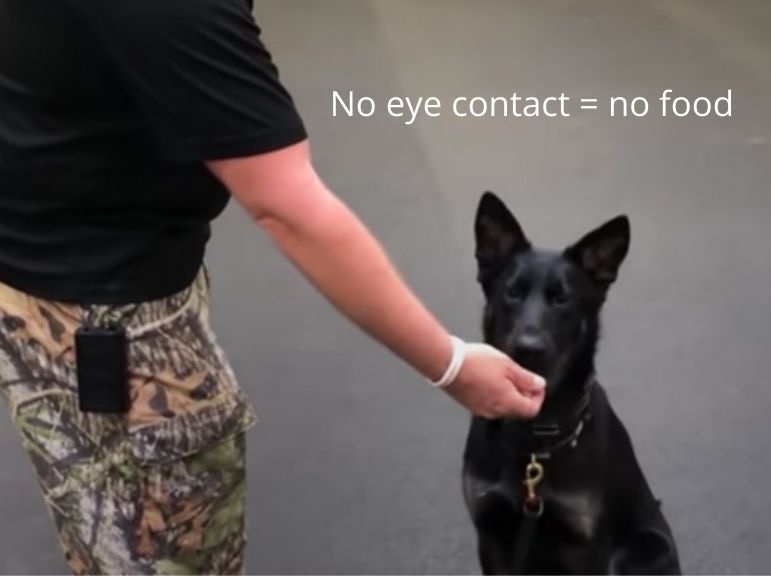
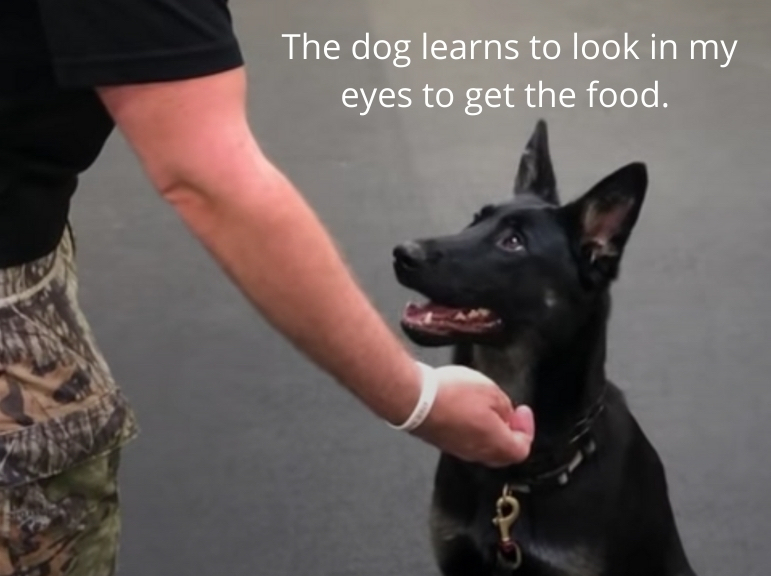
In this video, I’ll show you how easy it can be to get a pushy dog, who really wants the food that I have, to calm down, pay attention by giving me eye contact and think, in order to get the food.

It’s so easy it could be considered lazy dog training!

If you enjoyed this video, please Subscribe to our YouTube channel (P.S. Click the bell icon to get notifications when we post a new video)

SUMMARY

  • The overly excited pushy dogs need to learn to calm down to eat and the weak dog needs to become pushier to eat.
  • Trainers and pet owners sometimes believe that food will make a dog too pushy and too jumpy.
  • People say, stand still and the dog will stop jumping. They will eventually but why not use food and create a thinking dog?
  • When a dog starts thinking, when they actually start using their brain, they stop the jumping and other unwanted behaviours.

dog not paying attention

  • Pay attention and look in my eyes to get the food reward.

Calm dog paying attention

  • Think of this:  if the dog charges at the bush (being overly excited), there will be no rabbits (food) in that bush.  When the dog figures out that if she looks into my eyes (calms down, and pays attention) it will make rabbits (food!) come from the bush and she eats.


The Liver Bites I use and train with every day.  Freeze-dried, all-natural liver bites with no preservatives.

Liver Bites - Dog Treats


treat pouch to hold high value food to calm the pushy dog
Unleashed Potential Training Pouch

Would you like FREE  puppy training or dog training advice? OR to just learn more about Duke’s philosophy on dog training?  GET ACCESS HERE to his exclusive, FREE mini-video series.  This mini-series is not found on YouTube… Get Access Now… You will love it!

Contact us HERE


Want to book a workshop with Duke Ferguson? CLICK HERE FOR MORE INFORMATION

FOLLOW US

Facebook Icon

YouTube Icon

instagram


Full Transcript-

Overly Excited Dog? How to Calm Your Dog Down and Get Attention in Minutes

[The following is the full transcript of this YouTube video. Please note that this video, features Duke speaking extemporaneously–he is unscripted and unedited. Filmed in one take].


Hey there, it’s Duke Ferguson, the owner CEO and master trainer of Unleashed Potential K9 and creator of Dog Training Genesis.

In this video, I want to address the myth that too many trainers and too many pet owners tell me about and that is food making dogs too amped, too pushy, too crazy and they can’t train them because they’re too hungry. That’s further from the truth. So in this video, I want to show you an actual example of how you can get a dog to use his brain, and to calm down and think, in order to get the food while you don’t have to do anything. The dog is the one that’s actually putting out, trying, and you’re barely doing anything at all. It’s just that easy. Here’s a clip from my Monroe, Washington seminar and it shows exactly that. I hope you enjoy it! Before you start the video, be sure to subscribe to see future videos, just like this one.

I want to address the myth that too many trainers and too many pet owners tell me about and that is food making dogs too amped, too pushy, too crazy and they can’t train them because they’re too hungry. That’s further from the truth.

So the pushy dog, remember I said, I’ll get her all amped. The pushy dog needs to learn to calm down to eat,  and the weak dog needs to put out to eat. So, let her push. I’m looking for anything.  Notice the pushiness just kinda stopped. I don’t care what she does I’ll either go…If I’m looking for eye contact she jumps on this board, I’ll mark that. I’m just getting her brain to work. I’m talking to you guys. This is a dog doing reactive stuff,  just what they know, what they can get away with. And she’ll learn to start using her brain and she’ll look into my eyes. I can sit on a chair. Do you want to see the look on her face? Just hang tight.

The overly excited, pushy dog needs to learn to calm down to eat,  and the weak dog needs to put out to eat.

The dog’s a bit nervous. When they are really hungry, touch. okay. We will go this way to see. There’s the food, I want eye contact. When a dog starts thinking, when actually start using their brain, they stop all this sh** and they think, huh, charging the bush… there are no rabbits in that bush. Ah,  See? Simple.

So in theory, people could say, stand still and the dog will stop jumping. They want you. They will eventually, but you’ll get all scratched to crap. If they want food, all they’re doing is licking and pushing on my hand. And I can discourage that pushiness, by taking it away. So, I can make it faster. So let’s say they’re really pushy when she goes to it, I pull away. You can play catch to build a little dopamine. So you can actually use your food as prey as well. Now I’m going to make it more distracting.  She learns, to get distracted by this you starve! Sit down and think, how do I get that? She doesn’t understand, right, so I make it easy. So notice I pull away. See the brain working?

So you can actually use your food as prey as well.

Put your camera right on her face, the look, she’s like. Come see it, just her head, this dog her brain, you can smell the wheels turning in there and there’s smoke coming out of her ears, every so often, it’s great! Okay. I can do this, all day, and she’ll learn to stare in my eyes. . So fast, “Chip” And it happens faster, faster, faster See it? See the eyes? She’s thinking. You want a thinking dog. No GPS help. I’m not doing this: Look, look, oh good girl! Don’t do that. Don’t do that. That drives me crazy. So now, you’re not paying her, and that’s okay? because she’s looking at you. Right, because she’s putting out and I can talk to you and she’s still thinking. Now I’m talking to you guys and look at the dog. She’s putting out. Yeah. So I don’t need to do the cheerleading and it’s less effort. That’s called lazy dog training. Look, here’s the pouch man, holy cow! Look at her thinking. “Chip” Look in the guy’s eyes, make rabbits come from the bush and eat it. She learns. Hey, pretty quick. That’s an easy thing I know what to do. I’m already waving around.  Notice how people are like “Don’t distract the dog.” “Don’t distract, In training, don’t distract my dog.”

I’m talking to you guys and look at the dog; she’s putting out.  So I don’t need to do the cheerleading and it’s less effort


Filed Under: Duke Ferguson, UPK9 Main Blog

The Art Of Attention In Dog Training

November 4, 2016 By Duke Ferguson Leave a Comment

What is “The Art Of Attention” In Dog Training?

Although we often show how much attention you can get from your dog in any distraction, the art of attention  is way more than just having the dog look at you.

See the video below to learn more information on what it is.

Got Dog Problems? Do you want help? No matter the size, sex, age or breed We Can Help!

Would you like  FREE dog training advice? OR to just learn more about Duke’s philosophy on dog training?  GET ACCES HEERE to his Exclusive, FREE Mini video series  Click Here!! This mini series is not found on Youtube… Get Access Now… You will love the mini series and its Free!! 🙂

To find a UPK9 Trainer near you or to Book your  FREE Demonstration and Consult Click Here

For more information on how you can  purchase Dog Training Genesis and become a member  CLICK  HERE or on the photo below of Duke and his dogs.

ARE YOU A TRAINER LOOKING TO BETTER YOUR SKILLS OR SOMEONE WANTING TO LEARN TO BECOME A DOG TRAINER or JOIN THE UPK9 TEAM ? CLICK HERE TO LEARN HOW YOU CAN COME AND TRAIN WITH DUKE FERGUSON

Fotor111122448
Learn More About Dog Training Genesis CLICK HERE !

Follow us on FACEBOOK  and subscribe to  us on YouTube

Filed Under: Duke Ferguson, UPK9 Main Blog

Adventures in Reactive Dog Encounters Part 1

May 8, 2016 By Duke Ferguson Leave a Comment

Introduction: The purpose of this blog series is not to judge, but to educate!

I learned long ago that most reactive dog owners do not always appreciate a stranger in passing giving them reactive dog advice about their loved ones. More often than not, people tend to take it personally when you point out their dog’s flaws, rather than as a gesture of good will. These days, I wait for people to come to me before I offer my thoughts and advice, but with the wonderful world of the anonymous web, what better way to spread some much needed knowledge than through stories of my adventures in encountering reactive dogs and the things that their owners could be doing differently to help. So here they are, one by one, for your education.

Adventures in Reactive Dog Encounters Part 1: Little Dog Syndrome

It’s a beautiful day, one of the first of the season, and that always means that the dogs are out in full bloom, including mine! Hiking is one of the many ways that we exercise our bodies and having off leash control means that I have more opportunities to exercise their brains as well. On hiking trails, the dogs can run, sniff, and tire themselves out, but when other dogs are heard or seen in the distance, I can recall them back with ease and put them into an off leash heel until we pass the strange dogs politely.

1 3

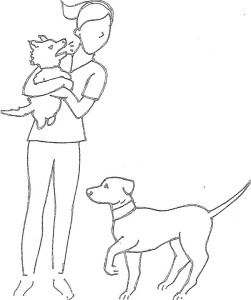
On this day in particular, we came across a number of dogs of varying breeds and personalities, and not once did I have to worry about my dogs’ safety, thanks to their training and ability to ignore distractions. Yes, you read that correctly, I worry about my pitbulls’ safety around other dogs, because despite what many people think and despite their breed, they are more friendly and well behaved than most other dogs out there, but I digress. One pack in particular that we came across consisted of two humans and two small breed dogs. As soon as the owners saw my two medium sized, completely relaxed dogs coming their way, they picked both dogs up into their arms where they were held until we were gone; the moment the dog was picked up, loud aggressive barking began and continued long after we had passed.

13180942_10207873071958793_1462539321_n
Sketch by Leslie Murphy of Hound Tales Inn Dog Daycare

Could the humans’ response have been based out of fear over breed? Maybe, it is certainly something that we have experienced many times in the past. Could it have been out of fear that their reactive dog might start something with a larger dog that could cause harm to him? Most likely. A logical response if you ask any unbiased bystander; pick the smaller reactive dog up to save everyone a lot of hassle and potential vet bills. Unfortunately, what the owners are probably unaware of, is that they may actually be causing more harm than good!

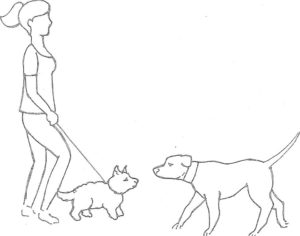
First, by picking up a smaller dog, a child, or anything of that matter, whether it is into your arms or up over your head, you are drawing unnecessary attention to yourself. Many dogs are used to avoiding a small barking dog, but a dog up in the air is rare and interesting, worth checking out at the very least, possibly even jumping up to get a better sniff. Now pick up a smaller dog around a prey driven, controlling, or reactive dog, and that dog might be more likely to jump up and nip or bite. The better idea would be to leave the dog on the ground, ask the strange dog’s owners if their dogs are friendly, particularly with small reactive dogs, and try blocking that dog from your own. If your dogs are likely to run at other dogs, they should be on leash until taught some impulse control.

13153304_10207873069838740_898116055_n
Sketch by Leslie Murphy of Hound Tales Inn Dog Daycare

Next, every time you pick up your smaller reactive dog and another dog, or person, passes by, your little dog has just ‘won’ and their reactive behavior has inadvertently been reinforced. The dog thinks, ‘dog approaches, I get picked up making me feel bigger and safer, I bark, dog passes, barking successful, I am safe, my pack is safe, next time I will bark again and my pack will be safe.’ Cue next dog on the trail and the cycle continues; ‘dog approaches, I get picked up, I bark, maybe I bark louder because it takes longer for dog to approach, dog passes, barking successful, we are safe, next time I will bark longer and louder and my pack will be safe’. Get the picture? It’s a vicious cycle that might be stopped by simply not picking up the dog. Will this stop the reactivity all together? Likely not, but it will stop reinforcing it, making it worse.

Also, when you hold your dog while they are barking, pet them, and tell them, ‘it will be ok, the strange dog will pass’, your dog hears, ‘it’s ok, good job, keep barking’, which reinforces the behavior even more. So remember to keep four legs on the floor at all times, and you will stop reinforcing Little Dog Syndrome, then book a free consultation with me to find out how I can help address your dog’s reactivity and need to bark at passersby.

5
Camellia Saunderson: Certified Professional Dog Trainer

Are you at your wits end with your dog’s behavior and would like to have control, sanity, and above all else, safety? No matter the age or breed, please contact me now,  I assure you, I can help!

Book your FREE consultation and demonstration today!
Send an email to camellias@upk9.ca  Like us on Facebook
!

Not in my area? Find a trainer near you! 

For more information on how you can  purchase Duke’s Dog Training Genesis and become a member  CLICK  HERE 

Filed Under: Camellia Saunderson, UPK9 Main Blog

Why I Became a Dog Trainer with

March 18, 2016 By Duke Ferguson Leave a Comment

me2

Why I Became a Dog Trainer

I never dreamed of being a dog trainer, in fact, it was never something I even considered until the day I decided to become one. So what lead me to that point?

In 2012, I opened a pitbull rescue which quickly became known for taking in difficult cases; that’s when I met my soul mate. In late October, I walked into the city pound and noticed this big-eyed blue beauty named Tank. In awe, I placed my hand on his kennel door and stated that if he was dog friendly, I was taking him home. Two weeks later I got a call telling me that he was in fact dog friendly, but he was extremely, irrationally fear aggressive toward people and thus would not be available for adoption. I went in to meet him and was given the choice to take Tank in under my rescue and save his life, or leave him for a very certain fate. Naturally, I couldn’t allow that to happen, so the very next day, he was mine. We started our relationship on the right foot, working with a trainer to overcome his issues, but after 7 months, a fight broke out between him and one of my own dogs, resulting in multiple serious injuries. At this point, I was left with another choice to make; either get Tank the help he needed or euthanize him. That was something I was not willing to do, despite what multiple other trainers were telling me, and adopting him out was certainly not an option. That’s when I called Duke Ferguson who introduced me to trainer Becky Herman, and in no time, Tank was on his way to bootcamp. It broke my heart to send him, but I knew it was exactly what he needed.

Tank was away at training for 2 months, the entire time of which I was terrified that he would come back the same dog and I would have to euthanize him anyway. To my sincere amazement, when Tank returned from training, I could walk him down the Halifax board walk on a sunny Sunday afternoon with children, adults, and dogs everywhere, and he just walked at my heel, looking to me for reassurance and ignoring everything else. He was truly happy, and so was I. I’ll admit at first I was terrified, but for once, it wasn’t because I thought Tank would bite someone, it was because I didn’t want to ruin this new dog that he had become. Thankfully, with lifetime group classes, ongoing support from multiple UPK9 trainers, and a truly amazing rehabilitation, that was the last thing that myself nor his new foster needed to worry about. My soul dog, the dog I knew he could be, was finally the dog everyone else could see too. That was the moment I decided I wanted to become a trainer, because I never wanted to experience such a horrific event again in my life, and I wanted nothing more than to help the dogs like Tank who truly need it and their owners who have found themselves in similar situations as I did.

Tank at the Halifax waterfront

To prepare myself, I left my job of 8 years for a position at the city pound where I could get firsthand experience handling dogs of all temperaments. It was during that time that I met Blitz, but unfortunately due to a non disclosure agreement, I cannot tell you the details of his background. Needless to say, I lost my job saving his life, which simply fast tracked my plans to becoming a pro dog trainer. As soon as I got Blitz out safely, I packed our bags and we were off to PEI where I attended Unleashed Potential k9 Academy and studied one on one with Duke Ferguson, living in his training centre with 5 other dogs in need of a little help.

20150930_123415~2

On April 4th, 2015, I opened Unleashed Potential K9- The Valley, dedicated to all dogs and owners in need, but specializing in aggression and bully breeds. Today, I am proud of the work that I do, and happy to say that if it wasn’t for the negative and extremely emotional experiences that led me to this point, I wouldn’t have the ability to help so many others in their time of need, just like Unleashed Potential did for me. Since my time in PEI, Blitz has become a CKC Canine Good Neighbor, friendly toward people of all types and all other dogs, happy, humble and obedient in all situations, and assistant to me, helping to train and rehabilitate other dogs and people in need too. I am also extremely thrilled to announce that today is the first day of the rest of Tank’s life. After 3 years of training, Tank has been adopted and will finally be going to his forever home. And THAT is why I became a trainer, to help dogs like Tank and Blitz find their true potential.

Blitz
Blitz’s Canine Good Neighbour Certificate


Are you at your wits end with your dog’s behavior and would like to have control, sanity, and above all else, safety? No matter the age or breed, please contact me now,  I promise you, I can help!

Book your FREE consultation and demonstration today!
Send an email to camellias@upk9.ca  Like us on Facebook
!

Find a trainer near you! 

For more information on how you can purchase Duke Ferguson’s Dog Training Genesis online, step by step training videos   CLICK  HERE 

Filed Under: Camellia Saunderson, UPK9 Main Blog

Footer

RSS The Weekly Recall with Duke Ferguson

  • #28 Four Ways Your Dog Is Trying to Communicate With You
    Why does your dog ignore you sometimes? Most people think it is a training issue. In reality, it is usually a communication issue. In this episode of Weekly Recall, Duke breaks down the four ways dogs actually communicate. Dogs do not rely on words the way humans do. They pay attention to scent, body language, […]

Home | Contact | Find a Dog Trainer | Dog Trainer School | Dog Training | Store | Blog | Privacy Policy


Follow Duke Ferguson on Facebook Follow Duke on YouTube Follow Duke on Instagram


Copyright © 2026 · All Rights Reserved

Unleashed Potential - Stratford, PE, C1B 2W2, Canada
Phone: (902) 367-3647 · Toll Free: (844) 364-3647

Hours of Operation:
Unleashed Potential Main Office:
Monday - Friday: 9am-4pm | Office closed on Saturdays & Sundays
Dog Training & Coaching - By appointment only